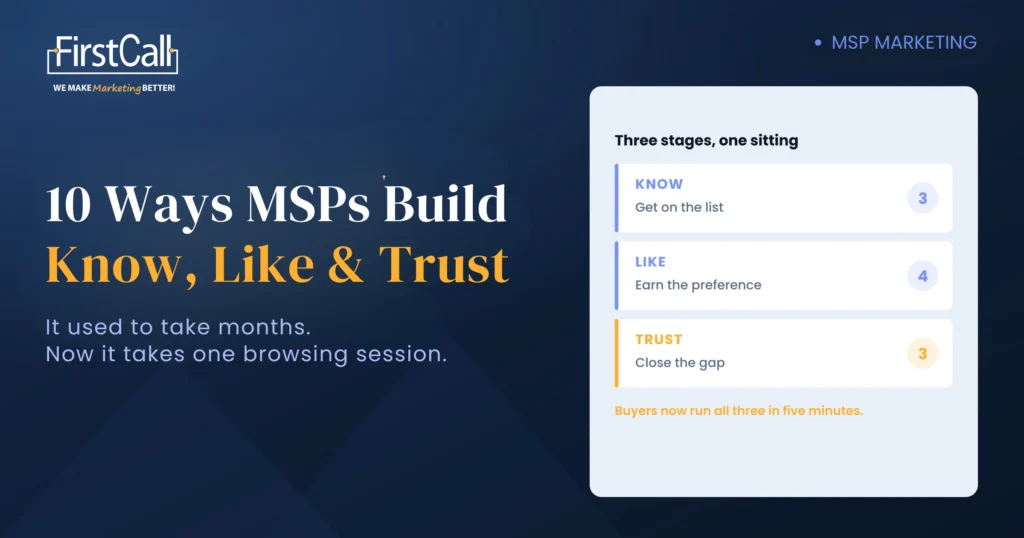
Know, Like and Trust has been marketing shorthand for about as long as marketing has had shorthand, and irritatingly, it still holds up. Someone has to know you exist, warm to you, and believe you before they’ll hand over the keys to their entire network.
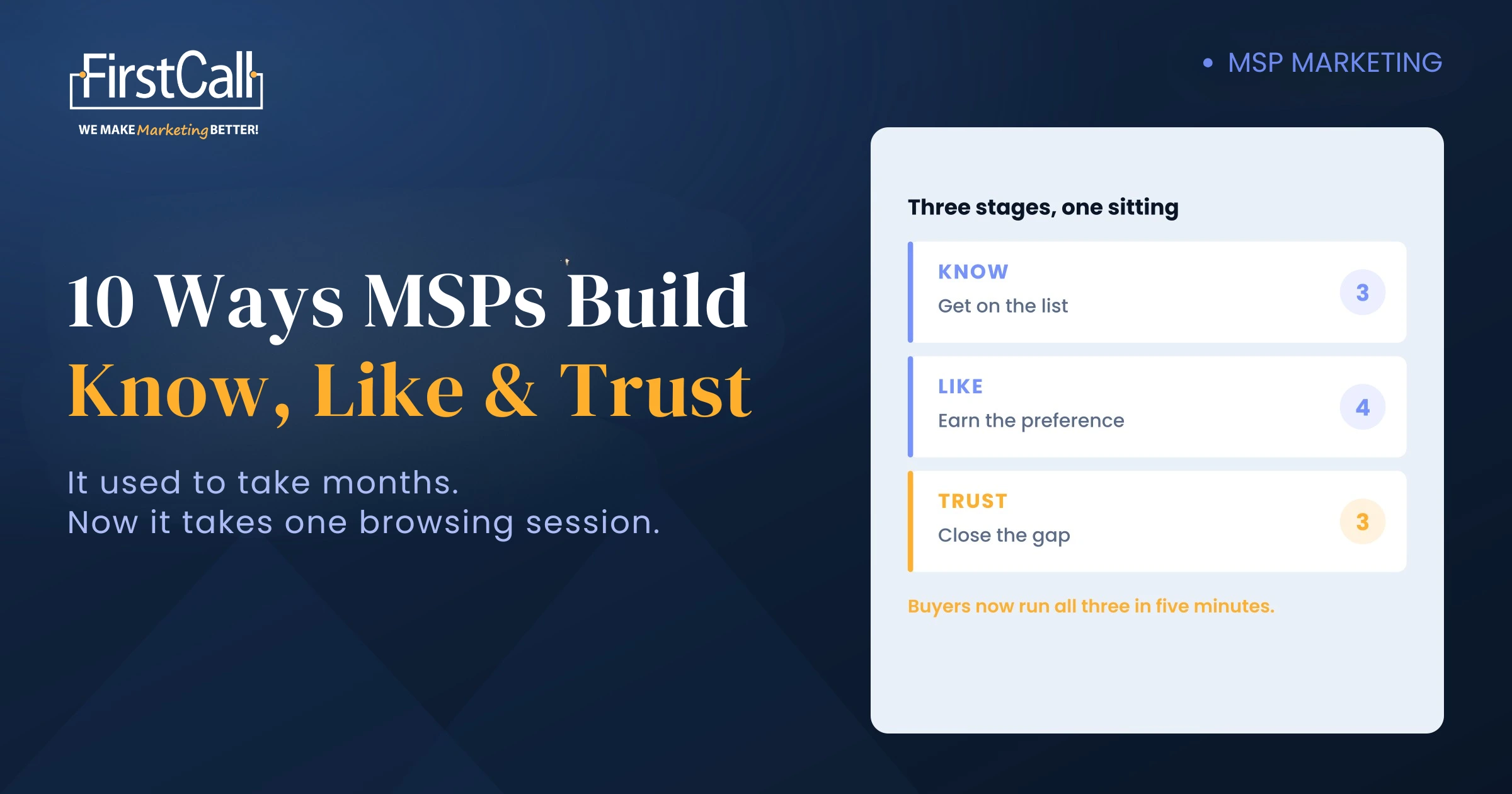
What’s changed is the timeline. When I first wrote about this in 2022, those were three stages you moved a prospect through over months. Today a business owner runs all three in about five minutes on their phone, and an AI assistant may have done the first pass before they open a browser at all.
That compression changes which of these actually earn their place for an MSP. Here are the ten I’d still bother with.
Know: getting on the list at all
- Consistent branding. Boring, and I’m putting it first anyway. If your logo, colors and name are inconsistent across your site, your Google profile and your LinkedIn page, you’re splitting recognition across what look like three different companies. Fix this before spending on anything else, because everything downstream compounds off it.
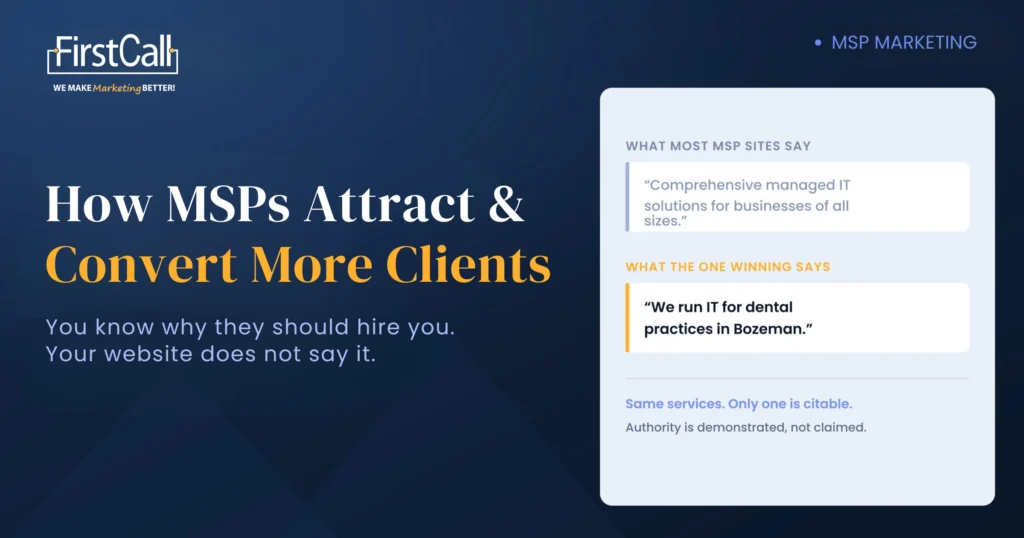
- Being specific enough to be findable. The old advice here was advertising, which still works and still costs money. The free version is simply naming who you serve. “Managed IT for accounting firms” gets found by a searching accountant in a way “comprehensive IT solutions for businesses of all sizes” never will, and the only thing it costs you is the courage to narrow down.
- Showing up where your buyers already are. For most MSPs that’s local business networks, chambers, industry groups, and the referral relationships that grow out of them. It’s still the highest-converting channel in the industry, and it’s the first thing everyone drops the moment they get busy. Yes, I see you.
Like: giving them a reason to prefer you
- An About page written by a human. It’s consistently among the most visited pages on an MSP site, and I’d argue it’s usually the worst one. Stock photos of people in headsets and a paragraph about your commitment to excellence tell a prospect nothing, except possibly that you bought a stock photo subscription. Who runs the company, why you started it, and what you’re actually like to work with tells them plenty.
- Social content that sounds like you. I’m not asking for daily posting, or a content calendar you’ll abandon by March like the last one. A handful of posts a month saying something you actually believe will outperform a scheduled stream of recycled vendor graphics.
- A frictionless experience. Broken links, forms that fail silently, a phone nobody answers. Every one of these quietly erodes preference, and they’re the cheapest items on this list to fix, because deep down you already know exactly which one I’m describing.
- Content that solves something before you’re paid. Answering a question your prospects genuinely have, in public, for free, is the most reliable way to be liked by someone who hasn’t met you. It also happens to be the thing AI assistants pull from, which we’ll get to.
Trust: the part that closes the gap to a signature
- Depth that proves you’ve done the work. Generic advice signals you read a vendor blog last Tuesday. Specifics signal you’ve been on the call at 2am, which is the only credential that matters to someone deciding whether to trust you with their infrastructure. “Test your restores quarterly, because a backup nobody has restored is a theory” is worth more than a page of best practices.
- Recent reviews. A good average matters less than recency here. A prospect weighing a provider switch wants evidence you were good last month, not evidence you were good in 2023. Ask right after you’ve resolved something well, rather than at renewal, when the goodwill is at its peak and nobody has to dig for a nice thing to say.
- Case studies with actual numbers. Pick a client, answer four questions: where were they when you met, what was breaking, what did you do, where are they now. Anonymize if you need to. The specifics are the entire value, so a case study without them isn’t one.
What’s different in 2026
Two things have shifted since this list was first written, and both matter more than any individual tactic on it.
The first is compression. Know, Like and Trust used to unfold across a nurture sequence. Now a prospect gets a referral, searches your name, reads three reviews, skims your About page and decides whether you’re worth a call, often inside one sitting. The stages haven’t disappeared, they’ve collapsed into a single session. That’s why consistency across your site, your profile and your reviews matters more than any one asset being excellent.
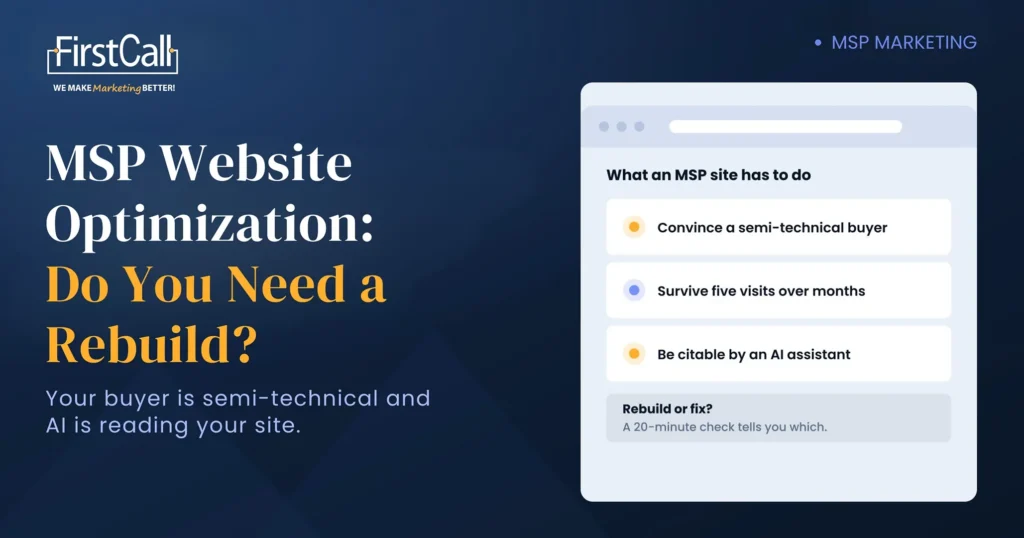
The second is that trust signals now feed machines as well as people. When someone asks an AI assistant to recommend a managed IT provider, the answer gets built from sources it can parse and trust. Specific, well-structured content gets cited. Vague content doesn’t exist as far as that answer is concerned. I went further into this in whether SEO is still relevant in 2026.
The practical upshot is that items 8, 9 and 10 have quietly become the most valuable on the list. Depth, recent reviews and real case studies build trust with a human reader and give an AI something concrete to work from at the same time.
Where to start if all ten feel like a lot
They are a lot. You don’t need them all at once, and anyone telling you otherwise is selling something.
If you’re starting from scratch, I’d do 1, 4 and 9 first. Consistent branding, a human About page, and a habit of asking for reviews. That’s a weekend of work and it fixes the three things a prospect checks fastest.
If you already have those, 8 and 10 are where the returns are. They’re slower, and they’re the ones your competitors are least likely to bother with.
If you’re not sure which of the ten is actually costing you, that’s exactly what our free MarketingStack Challenge is for. And if you’d rather see the whole picture assessed properly, our Marketing Strategizer covers this ground in depth.
Quick answers
What does Know, Like, Trust mean in marketing? It’s a framework describing what a prospect needs before buying: awareness that you exist, a positive impression of you, and confidence you can deliver. For MSPs it’s especially relevant because you’re asking a business to hand over responsibility for their entire technology stack.
How long does it take to build Know, Like and Trust? Less time than it used to. Buyers now often move through all three stages in a single online session, which means the assets doing the work, your site, profile and reviews, need to hold up under scrutiny simultaneously rather than in sequence.
Which trust signals matter most for an MSP? Recent reviews, content that demonstrates real operational depth, and case studies with specific outcomes. Those three carry the most weight with human buyers and are also what AI assistants draw on when recommending providers.